
Key Takeaways
- The concept for Trubar emerged during a household journey to Disney, where present snack choices left Groussman feeling “ucky” and “uncomfortable.”
- She began promoting protein bars by the checkout counter at native shops.
- Groussman offered Trubar for $173 million earlier this yr, and she stayed on as CEO.
She began with a picket tray from Bed Bath & Beyond, a handful of protein bars and a easy proposition for native companies: Put these on the counter, and see if prospects buy them.
They did. Then the small companies ordered more.
That scrappy check would become the basis of Trubar, the better-for-you snack company Erica Groussman constructed into a business now in 32,000 U.S. retail places. The company’s journey has included early retail wins, a stint under the umbrella of a public company and an eventual $173 million acquisition. Trubar has shipped practically 46 million protein bars in 2026, and the business grossed about $100 million in 2025.
Through it all, Groussman says that her secret is laborious work.
“I think that one of the biggest secrets is working your butt off,” Groussman says. “Really getting it into every hand that you can possibly get it into.”
The origins of a higher protein bar
Groussman didn’t begin out in the food industry. Early in her childhood, her mom gave her a newspaper route, an early lesson in incomes money and displaying up for work.
Groussman ended up finding out communications at UCLA, then labored in movie finance and real estate before getting married and having kids. She was a stay-at-home mother raising two kids when she got the concept for Trubar.
It all started during a household journey to Disney. Groussman had packed snacks, including a protein bar from an established model. It tasted good, she recollects, but it did not make her really feel good afterward.
“I remember just feeling very ucky,” she says. “My belly was very distended and uncomfortable. That was my epiphany. There has to be a better way.”
Her objective was not merely to develop a protein bar with a health-forward label. It had to fulfill a more troublesome commonplace: tasting like a dessert while avoiding the disagreeable aftermath she related with other bars on the market.
To create it, Groussman labored with a food scientist, relying on analysis, conversations and people in her personal community to discover the proper collaborator. The work was iterative and sensory. She still approaches product development by tasting, evaluating texture and diagnosing aftertastes.
“We’ll taste the bar, and I’ll say what I taste,” she says. “What am I getting afterwards? What’s the aftertaste? What do I want to see more of? Do I want more crunchy?”
Getting merchandise to prospects
After developing the idea, Groussman raised funds from household and mates and partnered with a food scientist and co-manufacturer to deliver the product to life. Trubar formally launched in 2018, with Groussman serving as CEO.
The earliest flavors included Daydreaming About Donuts, Oh Oh Cookie Dough, Saltylicious Almond Love and Smother Fudger Peanut Butter. The cookie dough taste was an early bestseller.
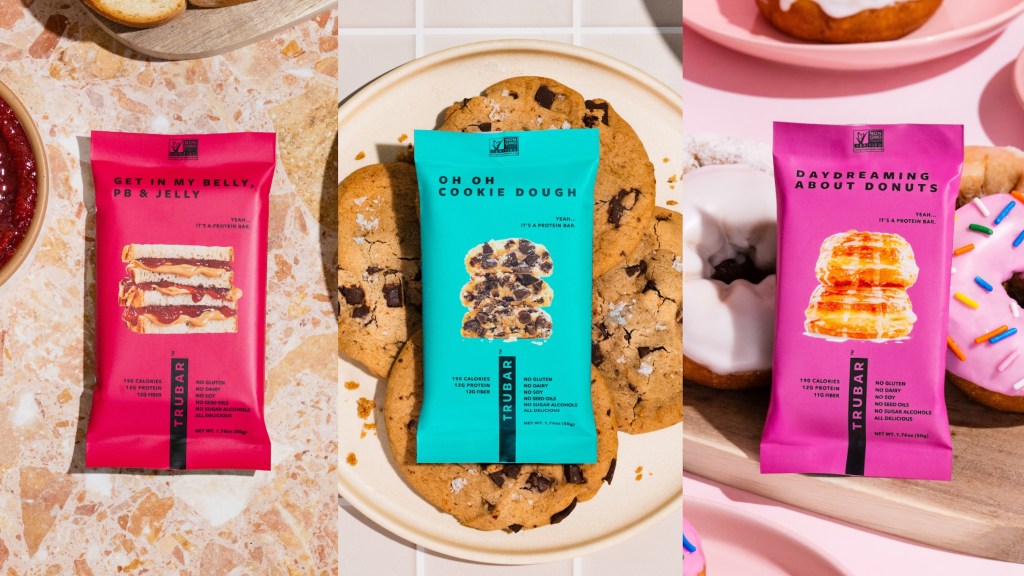
Groussman’s early proof of demand came from getting merchandise into people’s arms. She positioned bars on counters wherever native companies would let her. Juice retailers, delis, magnificence salons and unbiased shops grew to become her first gross sales channels.
“I put it on any counter I could possibly get, and I would just be like, ‘Here, sell these,’” she says.
The retailers set their own costs, usually around $3 to $4 a bar, and ordered more when the initial stock offered through. For Groussman, that easy loop validated the idea.
“That’s how I knew it was good because they were selling,” she says. “People were buying them and then asking to buy more.”
Making a expensive mistake
Groussman felt it was time to broaden beyond small shops. She says she initially sought help from an particular person she believed had more expertise operating a protein bar business. At the time, she was balancing operating the company with raising her kids and building a home.
Groussman introduced the particular person on to help handle Trubar, though she remained CEO. The association in the end proved expensive; the particular person’s spending outpaced the company’s early gross sales.
In retrospect, she says, she underestimated her own capabilities.
“I knew more than I thought I knew,” Groussman says. “We always doubt ourselves.”
The outside operator, she says, “ran it into the ground,” leaving the business with $7 million in debt. Trubar had made some early gross sales to smaller retailers, but that paled in comparability to the tens of millions of {dollars} of debt the business had accrued.
Groussman’s husband urged her to view the enterprise as a loss and transfer on. But she could not let it go.
“It’s a part of me,” she recollects telling him. “I really want to keep it going.”
Expanding into Whole Foods and Costco
Groussman turned to scrappy ways to get Trubar into greater retailers. One pivotal breakthrough came at Whole Foods. Groussman says she reached out persistently to a contact on LinkedIn and secured a trial in 30 places around 2020. With no advertising funds, Trubar grew to become the top-selling bar in those shops, she says, competing alongside established manufacturers such as RXBAR and Kind.
Costco was another early milestone, though not an rapid victory. Trubar first entered Costco in Canada with a single truckload during the Covid-19 period, Groussman says. The model struggled there, partly because it was less established in the Canadian market and may have confronted a pricing drawback as a U.S. model.
The U.S. rollout came later and proved far more profitable. That expertise bolstered a sensible level for CPG founders: A troublesome launch in one market does not essentially invalidate the product. Distribution strategy, model familiarity, price positioning and timing all matter.
Becoming the CEO of a public company
While Trubar was increasing into bigger retailers, Groussman was concurrently making behind-the-scenes modifications.
In 2021, Trubar was acquired by a publicly traded holding company as half of a broader company transaction. Groussman agreed to this construction because it allowed the business to broaden and her to stay CEO without taking on personal debt.
The holding company had a portfolio that included a skincare model and a CBD company. Eventually, the other companies failed while Trubar emerged as the strongest model in the group.
Groussman says the expertise was irritating. She describes a period when money generated by Trubar was used to support other companies in the portfolio, even as her own model was gaining traction.
But the upheaval also reshaped her function. She remained founder and CEO of Trubar, a title she had held since the model’s inception. In 2024, she added an further function. She grew to become CEO of the publicly traded company, which was renamed around the Trubar business and included Trubar alongside other companies in its portfolio.
“I was the only one standing,” she says. “I was a CEO of a publicly traded company.”
A hands-on CEO
Today, Groussman says Trubar has roughly 28 staff. Her management strategy is deliberately hands-on. Rather than positioning herself as a distant government with a high-level view of the business, she stays intently concerned in operations, product choices and emergencies.
She says staff can come to her when they need help, and she tries to lead by instance. “I will not ask you to do something that I wouldn’t do myself,” she says.
That philosophy lately performed out during a new product launch for Walmart. One of the shipments was expected to arrive late, threatening the timeline. Groussman started calling packaging contacts outside the company’s regular provider community and discovered a supplier that could full the job in two weeks.
“I like to make sure the wheels are moving,” she says. “When anything is slightly going wrong, I’m like mama bear. What do I gotta do? Who do I need to talk to?”
Another situation concerned a mislabeled product box. The merchandise and ingredient checklist were appropriate, she says, but a front-facing aspect incorrectly referred to cashews instead of almonds, or vice versa. The group immediately sourced inexperienced round stickers from close by Staples shops and utilized them on-site to appropriate the error before supply.
The rapid response mattered, but so did the follow-up investigation. “The next week after we fixed it all and it’s all okay, that’s when you go back, and you say, ‘Where did this mistake happen?’” she says. “What is broken in our path?”
Advice for CEOs
Groussman’s bigger working philosophy is to resolve first and diagnose issues second. She says groups can become paralyzed by a need to have every element in place before appearing. She says that intuition can become a legal responsibility for founders.
“Just get 80%, just go,” she says. “Just start, just do what you can do and just start etching away and moving in the direction.”
She has a equally pragmatic view of hiring. “You interview for your resume; you hire for chemistry,” Groussman says. In a fast-moving and sometimes chaotic atmosphere, she appears for people who can make choices, take initiative and thrive.
“I want my team to be able to make decisions and to grow,” she says. “If they come up with an idea, try it. What’s the harm?”
Scaling after an acquisition
Earlier this yr, Trubar was acquired by Eti Gida, a Turkish snack company, for $173 million, according to Groussman. She stays at the helm as CEO and continues to run day-to-day operations. Her group is also still intact, a situation she seen as important in evaluating potential companions.
For Groussman, the acquisition marks a new stage rather than an ending. Trubar launched Trubar Kids last yr and lately launched Trubar Pro. She also sees room to prolong the model into other classes.
“It was always known that they wanted to keep me as well as my team,” she says. “I’m not done. It’s my baby.”